Gray Card in Photography Explained
A gray card is one of those photography terms you hear constantly but rarely really understand. Here’s the core principle behind it — and why photos often look different from what you actually saw, even with correct camera settings.
01Why Colors in Photos Sometimes Just Look Wrong
You dial everything in, take the shot, and check your camera’s display. It looks fine, but something feels a bit off. The real disappointment usually hits later, on your computer screen: the colors look slightly shifted — not dramatically wrong, but not quite what you remember seeing on location either.
The problem simply comes down to how the camera interprets light. A camera doesn’t actually know what “white” is. It has no sense of mood or atmosphere — it just measures how much light hits the sensor and in which color proportions. The seemingly wrong result happens when that information gets misread and the camera lands on the wrong white balance.
There’s actually a good intention behind this: the camera always wants to give you a neutral, “clean” image. But when the scene is bathed in a specific light — say, the warm gold of a sunset — the auto system tries to correct that mood instead of just leaving it alone. That’s exactly where it misjudges the situation.
Point a camera at a white wall in warm sunset light, for example, and it doesn’t see a “white subject” — it mostly sees orange-toned light. It then tries to nudge that light back toward neutral. In moments like this, it’s not really about the subject at all, just the light bouncing off surfaces back to the sensor.
And that’s exactly where a frequently underrated tool comes in: the gray card. It acts as a neutral reference for reading light and color reliably. Thanks to its specific surface, it gives the camera a fixed point to orient around — no matter how complex or moody the lighting actually is.
02What a Gray Card Actually Is
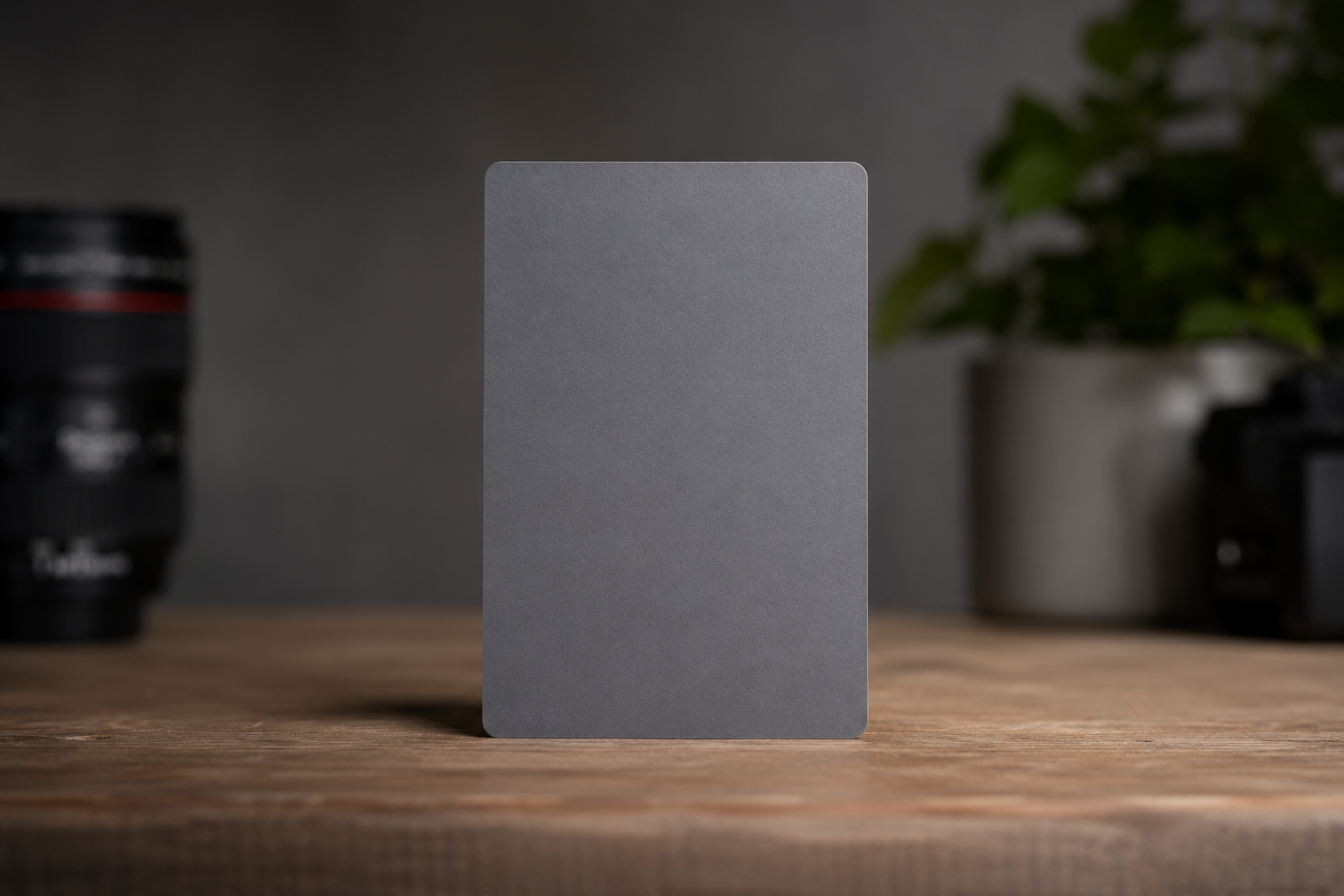
At its core, a gray card is exactly what it sounds like: a card in a precisely defined shade of gray. It’s built to reflect light evenly, without any color cast of its own, regardless of the light source.
That’s the key part. This specific gray corresponds exactly to the fixed value cameras are calibrated around. Where auto systems often have to guess with a colorful or high-contrast subject, the gray card hands the camera exactly the target value it’s already looking for. It sits right in the middle.
This is a massive help if you shoot RAW. The card works as a one-time reference for a given lighting situation: hold it briefly where your subject will be, take a test shot, then set it aside.
Later, on your computer, a single click on that test shot tells your software exactly what the light looked like on location. Because the gray card gives you a fixed value, the software can precisely match colors across every other image shot in the same light. No more guessing at color sliders — you’ve established one consistent baseline for the entire series.
03Why Gray Cards Get Misunderstood
You know the feeling: colors look flat, or snow suddenly reads as dirty gray. That’s usually the moment people reach for a gray card, thinking purely about white balance. That’s not wrong, but it’s only half the story.
A standard gray card is calibrated to a reflectance value of exactly 18 percent. This tone is called middle gray because it sits precisely between black and white — for your eye, and for the sensor.
Cameras use this exact middle gray as their reference for metering. In a sense, the camera “thinks” in grayscale. It tries to expose whatever it sees so that it matches this neutral value. That’s why a gray card isn’t just a color tool — it’s a stable reference point for light overall, especially when very bright or very dark subjects throw the auto system off balance.
One important thing to keep in mind: a gray card doesn’t “know” anything. It simply gives the camera a fixed, unmovable reference point to work from.
04Why Many Gray Cards Show More Than Just Gray
If you’ve ever held a gray card set for the first time, you’ve probably wondered about the white and black panels next to the gray one. The reason is purely practical: the gray panel is the ideal value — but it’s not measurable well in every lighting situation.
In very dark environments, gray reflects so little light that the camera barely gets a clean signal. That’s where the white panel steps in as a backup anchor.
In extremely bright situations, the black panel helps establish a controlled reference point without the reading running into the limits of the highlights.

05Why White Paper Is Rarely a Good Substitute
Wouldn’t a plain white sheet of paper just work? A lot of people try it because it’s always on hand. The problem is that “white” in everyday life is rarely truly color-neutral.

Paper often contains optical brighteners that create a slight blue cast under daylight. Your camera then reads already-tinted light instead of a truly neutral one — and sets its white balance based on that skewed reference.
That leads to the classic frustrating moment: you did everything right, and the colors still look somehow off. Not because the camera failed, but because the reference itself wasn’t neutral to begin with. A gray card, by contrast, is made from deliberately color-neutral material. It’s not about perfectionism — it’s about reliability.
06Takeaway: A Fixed Point in Any Light
The gray card sounds unremarkable, but it’s one of the most reliable tools for keeping color and exposure under control. It doesn’t guess, it doesn’t interpret — it gives your camera or your software a fixed reference point to work from, no matter how complicated the lighting gets.
Next time your colors feel off despite correct settings, reach for the gray card before you start guessing at sliders. One reference shot can save you the color correction on an entire series.
To see exactly how to put that reference point to work for white balance, check out our guide on white balance in photography.
Frequently Asked Questions About Gray Cards
What reflectance value does a standard gray card have?
A standard gray card is calibrated to a reflectance value of exactly 18 percent. This tone is called middle gray because it sits precisely between black and white for both the eye and the sensor.
Do I need a gray card if I shoot in RAW?
It’s especially useful in RAW. You photograph the card once as a reference in a given lighting situation, then use that shot to precisely match colors across every other image from the same series later on your computer.
Can I use a white sheet of paper instead of a gray card?
Not reliably. Paper often contains optical brighteners that create a slight blue cast in daylight. Your camera then reads already-tinted light instead of a truly neutral reference.
What are the white and black panels on a gray card for?
They step in when middle gray isn’t reliably measurable — the white panel in very dark environments, the black panel in extremely bright situations.