Dynamic Range in Photography Explained Simply
The sky looks stunning on your screen, but the ground is pure black? That’s dynamic range — and it depends less on your camera than you’d think.

01What Is Dynamic Range, Really?
Put plainly, dynamic range describes the difference between the brightest area of an image that still holds detail and the darkest area where detail is just barely still visible. It’s about the brightness span a camera — or your eye — can process at the same time without losing information.
That “at the same time” is the key part. Any camera can shoot bright. Any camera can shoot dark. The real question is whether it can do both in the same moment — with structure, with gradation, with visible detail.
That sounds technical at first. And yes, it is a technical term. But its effects don’t show up in a spec sheet — they show up in situations most people have run into themselves.
Maybe you’ve experienced this: you’re photographing a landscape, and on your screen the sky looks fantastic — beautiful colors, crisp clouds. But the ground below is nothing but a black, structureless mass. Or it’s the reverse: the foreground is perfect, but the sky is just a blown-out white field.
In moments like these, you’re looking at exactly what dynamic range means. It determines whether bright clouds and dark shadows can both hold onto their detail at the same time — or whether one of those areas “falls off the edge” and loses all information.
And that’s exactly where a technical term becomes a practical issue. Because dynamic range determines how much of what you actually saw on location ends up visible in the final photo.
How this brightness distribution shows up within an image becomes especially clear in the histogram.
02Why Your Eye Sees More Than Your Camera
Here’s something a lot of people underestimate. When we talk about dynamic range, we’re unconsciously comparing the photo to what we ourselves perceived. And that’s exactly where the confusion usually starts.
The human eye has an enormously high dynamic range. Not because it’s technically superior, but because it’s constantly adapting. It doesn’t work with a single fixed exposure like a camera — it continuously reacts to changes in light, adjusting and balancing brightness in fractions of a second.
You look up at the bright sky, and your eye adjusts. Then your gaze drifts down into dark shadows, and another adjustment happens there too. Your brain stitches these impressions together into one coherent picture. To you, it feels like you’re seeing everything clearly at once. In reality, seeing is an interpretation: brightness levels get evaluated, differences get balanced out, and individual impressions get merged into a harmonious whole.
This is exactly where the camera differs. It can’t keep making these adjustments on the fly. It makes a single exposure decision — for that one specific moment.
That’s why a scene can look perfectly balanced to you while the photo suddenly shows extreme contrast. It’s not that your camera is failing. Unlike your vision, it can’t apply a flexible interpretation — it has to commit to a fixed brightness distribution within the limits of its technical dynamic range.
03Typical High Dynamic Range Situations
Dynamic range becomes especially obvious in situations where extreme brightness differences collide. These aren’t rare edge cases — they’re subjects you run into constantly in everyday photography.
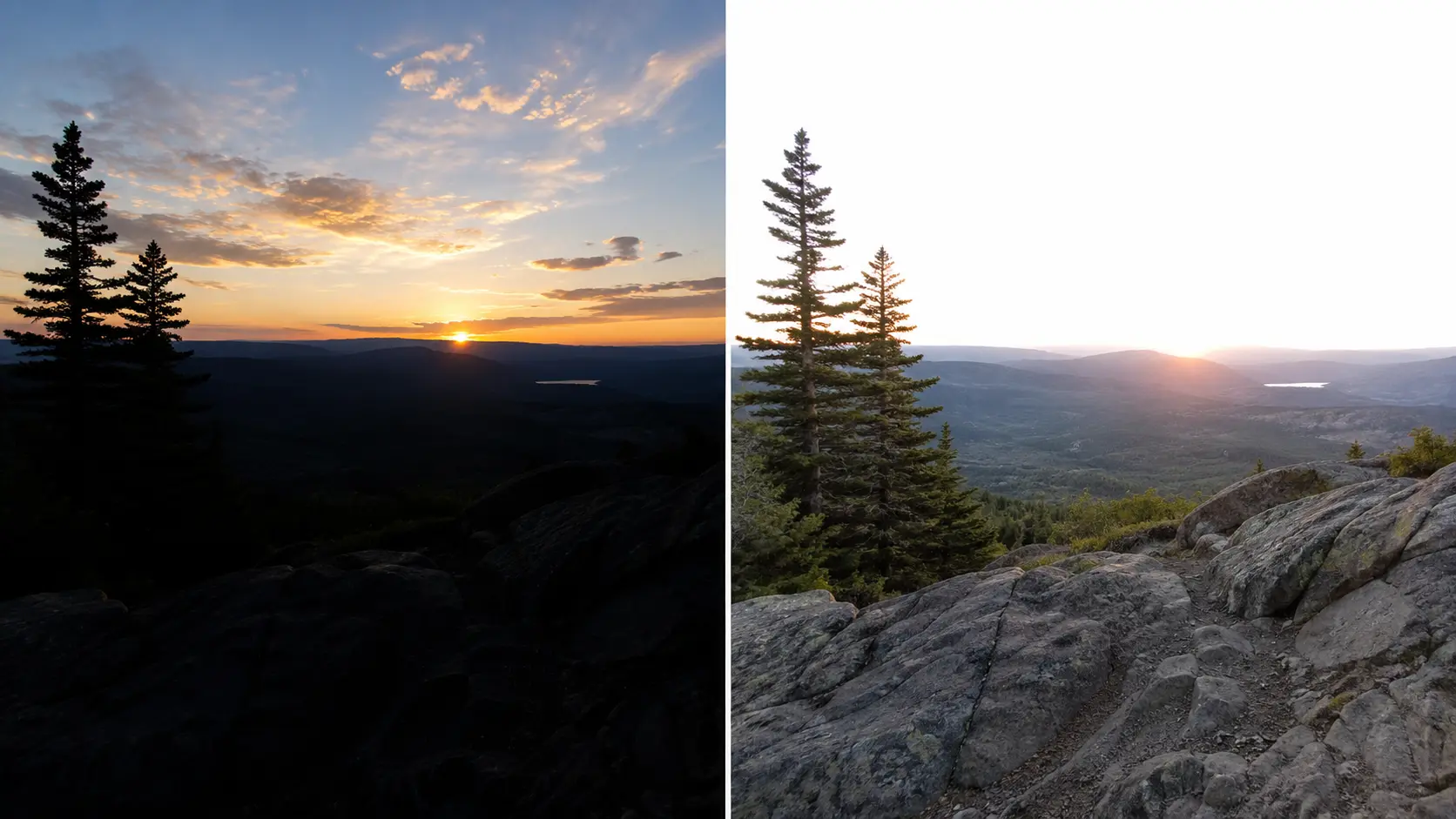
A classic example is a sunset with a dark foreground. The sky glows intensely while the ground below is already in shadow. To your eye, this scene looks balanced — you can see the colors in the sky and the structure in the foreground at the same time.
The moment you point a camera at it, things change. Expose for the bright sky, and the foreground quickly loses all structure. Expose for the foreground instead, and the sky blows out into a featureless white field. The camera simply can’t fit that entire brightness span into a single exposure once it exceeds its dynamic range.
A similar effect shows up indoors with a bright window. While your eye clearly picks up detail both inside the room and outside, the camera has to pick a priority. Either the room stays correctly exposed and the window blows out, or the window keeps its detail and the room turns too dark.
The underlying principle is the same in both cases: what matters isn’t the subject itself, but the brightness span within the scene. Whenever very bright and very dark areas exist side by side, the camera’s dynamic range hits its limit.
In particularly high-contrast situations, some photographers turn to HDR (High Dynamic Range) techniques, combining multiple differently exposed shots to capture a wider brightness span than a single exposure could manage on its own.
We’ll cover how HDR works technically and when it’s worth using in a separate article on HDR.
04What Determines Dynamic Range?
Dynamic range isn’t a feature you can switch on in your camera’s menu. It’s a technical property of the sensor itself. Every camera ships with a certain built-in brightness range, and that range varies depending on the hardware. Three factors matter most here:
This is the biggest factor. Larger sensors (like full-frame) generally have larger pixels, which can gather more light. Smartphones try to offset this physical disadvantage with clever software and automatic HDR processing. But in extreme-contrast situations, software eventually hits its limits, while a large sensor can still deliver detail with ease.
This is a common point of confusion. Raising your ISO makes the image brighter, but it actually reduces your usable dynamic range. You’re amplifying the signal, yes — but you’re amplifying noise right along with it, and that noise eats away at fine detail in shadows and highlights. A higher ISO doesn’t give you more headroom; it narrows it.
When you shoot in RAW, your camera stores the maximum brightness information your sensor is capable of capturing. A JPEG, by contrast, is already “baked” and compressed — and a lot of nuance gets lost in the process. RAW doesn’t magically improve your sensor, but it does make sure you can actually use the available headroom during post-processing.
That’s exactly why the standard advice is: keep ISO as low as possible and shoot in RAW. Not to fix your exposure after the fact, but to keep as much room as possible to work with.

05How Is Dynamic Range Measured?
Dynamic range is technically measured in what are called stops. A stop describes a doubling or halving of the amount of light. So when photographers talk about more or fewer stops, they’re referring to precisely defined brightness differences between very bright and very dark areas.
If a camera has, say, a dynamic range of 14 stops, that means it can capture a wide brightness span between the darkest area that still shows differentiation and the brightest area that still holds structure. Technically speaking, this number describes the brightness range the camera is capable of recording.
But a word of caution: these figures are lab-measured technical values. They’re a solid point of reference, but not the sole measure of quality. What ultimately matters isn’t what’s theoretically possible, but how clean the detail actually looks in the finished image.
This shows up clearly in the shadows especially. Detail that exists in theory can, in practice, be swallowed by noise or lose clarity when pushed too hard in editing. So the measured dynamic range describes a technical framework — not automatically the visible result in every situation.
At the end of the day, stops are a reference point. They tell you how much headroom is theoretically available, but nothing yet about how balanced or contrasty an actual image will look.
06Dynamic Range vs. Contrast — A Common Misconception
This is where two terms that sound similar but describe completely different things tend to blur together: dynamic range and contrast. Because both deal with light and dark, people frequently treat them as the same thing.
Contrast describes the visible difference between bright and dark areas within an image. It directly shapes how the image feels. A high-contrast photo looks crisp, hard, or dramatic. A low-contrast photo looks softer and calmer — think of a foggy morning where landscape and sky blend into similar shades of gray.
Dynamic range, on the other hand, doesn’t describe the visual effect at all — it describes the camera’s technical capability. It tells you how wide a brightness span can be before information starts getting lost in very bright or very dark areas. It’s not about how strongly light and dark stand apart from each other, but about how much of that gradation can actually be captured in the first place.
This distinction gets overlooked constantly. An image can look extremely contrasty even though the shot’s dynamic range was limited — for instance, when bright areas are already blown out and dark areas have lost all detail.
You’ve probably seen this in shots taken under harsh midday sun: the sky turns into a flat white field, shadows under trees become solid black. The contrast is extreme — but the dynamic range simply wasn’t wide enough to capture both areas with detail.
The reverse is also true: a camera can have a huge dynamic range while the finished image is deliberately styled to be low-contrast. In that case, plenty of brightness gradation is available, even if the image looks calm and soft at first glance.
This sounds straightforward in theory, but in practice it frequently leads people astray. Anyone who confuses contrast with dynamic range often ends up looking for the cause of blown highlights or crushed shadows in the wrong place. It’s not a stylistic choice at play — it’s a technical limit of the shot itself.
07Why Dynamic Range Confuses Beginners
Dynamic range trips up a lot of beginners simply because it’s not directly visible. You can’t spot it the way you’d spot a wrong aperture or a shutter speed that’s too slow. It only shows up indirectly — through its consequences.
Nobody looks at a photo and thinks, “This is missing two stops of dynamic range.” Instead, other things stand out. Bright areas suddenly look flat and structureless. Shadows appear pitch black with no detail. Transitions between light and dark look harsh, almost clipped.
In moments like this, people usually start hunting for a cause. Was the exposure wrong? Is the camera not good enough? Did I miss something? This is exactly where confusion sets in, because the visible problem gets attached to the wrong explanation.
Here’s the key thing to understand: dynamic range isn’t an effect you add on purpose or “fix” with a single setting. It’s the technical framework within which an image can exist. When a scene has a wider brightness span than the camera can capture, certain areas are inevitably going to lose detail.
Once that clicks, your whole perspective shifts. It’s no longer about trying to perfectly “balance” every single photo — it’s about recognizing where the limits are and working with them deliberately.
08RAW, Shadow Recovery — and the Misunderstanding Behind It
Sooner or later, you’ll run into the advice: “Shoot RAW, and you can fix anything.” Especially in the context of dynamic range, that sounds like an easy fix — more headroom, more flexibility, less risk. At least, that’s the expectation.
And yes, RAW files do contain more brightness information than JPEGs. They store finer gradations between light and dark and give you more room to work with in post-processing. Shadows can be lifted, highlights carefully pulled back, contrast controlled with more precision. The usable dynamic range appears larger because more information is preserved.
What’s easy to miss, though, is that RAW doesn’t expand the sensor’s physical dynamic range. It simply preserves the captured brightness information as completely as possible. If an area is fully blown out, or a shadow has no detail left in it, there’s no image data left to recover — not even in RAW.
Whatever wasn’t captured can’t be reconstructed by even the best software. This is exactly where expectation and reality part ways. RAW isn’t a universal fix-it tool — it’s a format that gives you more room to work within the limits that already exist.
Once you understand that, your whole approach to exposure changes. It’s no longer about “fixing” mistakes later — it’s about keeping the limits of dynamic range in mind while you’re actually shooting.
09What Dynamic Range Really Means
At the end of the day, dynamic range isn’t really about numbers, measurements, or spec sheets. Those figures can be helpful, but they’re not the core of the topic. What matters is understanding what’s actually going on.
Every scene has its own brightness span. An overcast day has a completely different light distribution than a harsh sunset with deep shadows. At the same time, your camera has a fixed brightness span within which it can render detail with any real differentiation. These two ranges — the scene’s and the camera’s — aren’t automatically the same.
When a scene’s brightness span exceeds your camera’s dynamic range, you simply can’t capture everything with full detail at once. Something inevitably gets lost. Either very bright areas blow out, or dark areas sink into black. That’s not user error — it’s a physical limit.
Understanding this changes how you think about exposure entirely. It’s no longer about hitting some single “technically correct” exposure, as if one perfect setting existed. Instead, it becomes clear that every exposure decision is also a decision about priorities. You choose which parts of the image keep their detail — and where you’re willing to accept a compromise.
How that prioritization actually gets controlled comes down to the interplay of ISO, aperture, and shutter speed — which you can read more about in our article on the exposure triangle.
Dynamic range isn’t some niche topic reserved for gearheads. It’s the fundamental reason photos sometimes look different from the scene you actually experienced in person. And once that connection clicks, a lot of seemingly confusing problems start to make sense. Blown-out highlights or deep, detail-less shadows stop feeling mysterious and start feeling logical.
Frequently Asked Questions About Dynamic Range
What does dynamic range mean in simple terms?
Dynamic range describes the brightness span between the lightest and darkest areas of an image that a camera can capture with detail at the same time. Once that span is exceeded, information is lost either in the highlights or in the shadows.
Why does dynamic range drop at high ISO?
A high ISO value amplifies the sensor’s signal — but it amplifies image noise along with it. That noise buries fine detail in shadows and highlights, shrinking the usable dynamic range even though the image looks brighter overall.
Can shooting in RAW increase dynamic range?
No, RAW doesn’t change the sensor’s physical dynamic range. What it does is preserve more of the brightness information actually captured, giving you more room to work with in post-processing. Whatever wasn’t captured at the moment of shooting can’t be recovered, even in RAW.
What’s the difference between dynamic range and contrast?
Contrast describes the visible look of an image — how strongly light and dark areas stand apart. Dynamic range, on the other hand, describes the camera’s technical ability to capture a given brightness span with detail at all. An image can look highly contrasty even though the shot’s dynamic range was limited.